IoT Network Working Principles
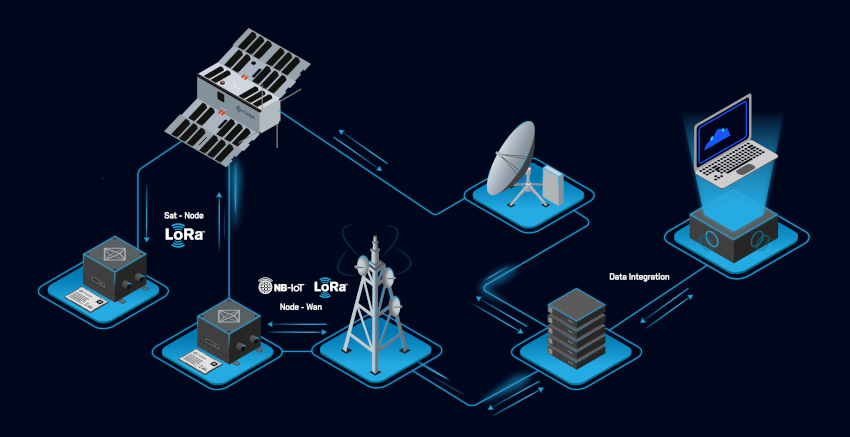
IoT data is generated by sensors connected to the FOSSA Nexus device, either via cable or wirelessly. NEXUS can operate as a concentrator or gateway for other nodes to communicate with the satellite network, or it can host its own wired sensors directly.
When a satellite passes over a FOSSA Nexus device, it emits wake-up beacons to notify the device that a transmission opportunity is available. Upon receiving the beacon, FOSSA Nexus transmits its IoT packets to the satellite. These packets are authenticated and stored onboard until the satellite is within range of a Ground Station, where they are downlinked. Once received, the packets are forwarded to the FOSSA Server for deframing and identification before being routed to the appropriate client server.
If the FOSSA Nexus device has terrestrial network connectivity, it can send IoT packets directly to the FOSSA Server without relying on the satellite network.
Users can also send telecommands to their devices via the satellite network. Commands are scheduled for transmission onboard a satellite and delivered to the FOSSA Nexus device when it comes into view.
⚠ Warning: The transmission of telecommands and wakeup beacons via the satellite network is subject to the regulatory framework applicable in each country.
Network Concepts
IoT Message
An IoT Message is a packet that carries user data from the device to the cloud through the FOSSA Network. This data is generated normally from sensors. In other types of IoT Neworks this might be known as Uplink frame.
IoT Command (work in progress)
An IoT Command carries information from the cloud to de devices through the FOSSA Network. This information is used to execute an activity or change a parameter on the device. In other types of IoT Neworks this might be known as Downlink frame.
Transmission Queue
FOSSA Nexus uses a simple transmission schema based on a 5-packet queue. This queue follows a FIFO (First In – First Out) logic, meaning the first packets inserted are the first ones sent to the FOSSA Network.
If a packet is removed from the queue for any reason, the next packet shifts into the empty position. This process repeats until all packets are moved forward, leaving any empty space at the end of the queue.
Packets in the transmission queue are not removed immediately after a successful transmission. Instead, FOSSA Nexus retains each packet until it has been transmitted a sufficient number of times to ensure high confidence that it has reached the satellite network. Once this threshold is met, the packet is cleared from the queue, allowing subsequent packets to move forward. This process helps maintain reliable delivery while optimizing queue space. For more information about queue space management, please contact FOSSA.
Packets can be inserted into this queue through external interfaces such as I2C, One-Wire, UART, RS485/422, Serial Terminal, and Wi-Fi. They can also be inserted using measurement interfaces like ADC and 4–20 mA sensors. Check Operation Manual for more information.
If a packet is attempted to be inserted when no space is available in the queue, the insertion is rejected.
Encryption
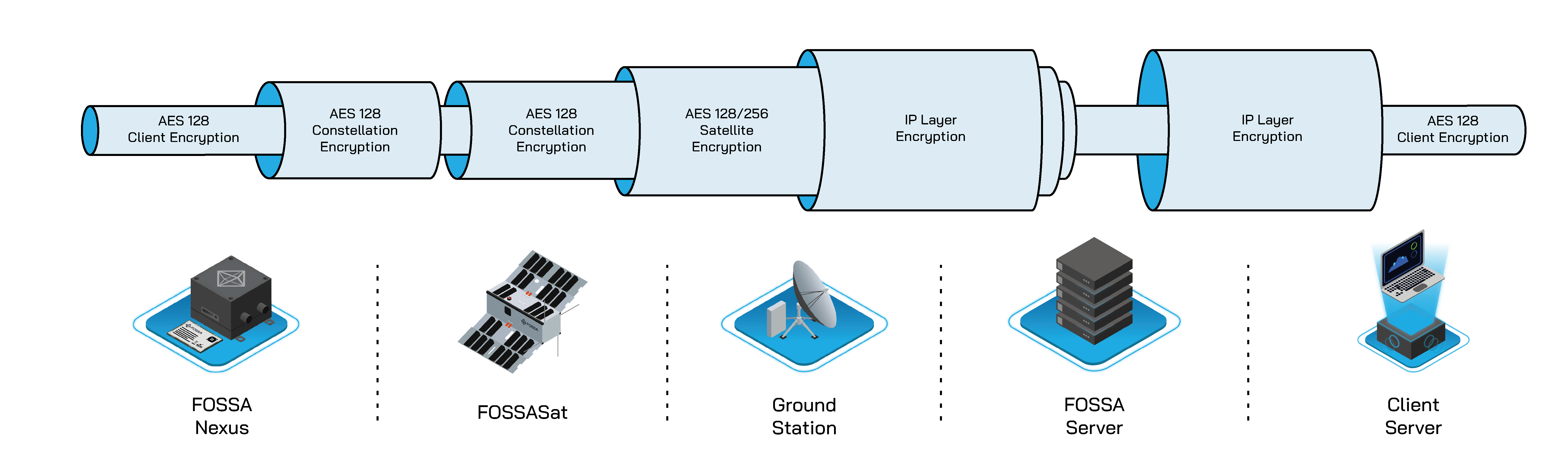
FOSSA Nexus incorporates an end-to-end encryption system to protect information transmitted via both LoRa and cellular networks. It uses the Advanced Encryption Standard (AES-128), a symmetric block cipher widely adopted for securing classified data. Encryption and decryption processes are handled by a secure cryptographic integrated circuit embedded in the device.
To ensure data integrity and confidentiality, IoT data is first encrypted using the client AES-128 key within the FOSSA Nexus device (or connected nodes). The node then adds the necessary headers and applies a second layer of AES-128 encryption using the constellation key before transmission to the satellite.
Upon reception, the satellite decrypts the constellation layer to authenticate the packet, re-encrypts it for secure storage, and later downlinks it to the ground station. Once received by the FOSSA server, the constellation encryption is removed, and the packet—still protected by the client encryption layer—is forwarded to the client server with IP-level encryption. This multi-layered process guarantees the security and confidentiality of the client’s data throughout the entire transmission chain.
Cellular VS Satellite connectivity
FOSSA Nexus may incorporate, as an optional feature, a mobile network modem. This enables connectivity to cellular mobile networks, which are available in more than 180 countries.
With this modem, the FOSSA Nexus can use mobile networks as an additional backhaul for IoT communications, such as sending commands or IoT packets. When the modem is included, an extra configuration defines how often these connections are executed (typically once per week).
When a mobile network connection is established, any IoT packet marked for cellular transmission will be sent through this channel, reducing overall transmission latency.