Register your Device
The FOSSA IoT Hub will allow you to create and manage your organization, register and group your devices, and even define endpoints to receive the information sent by them.
1. Register your oganization on the FOSSA IoT Hub
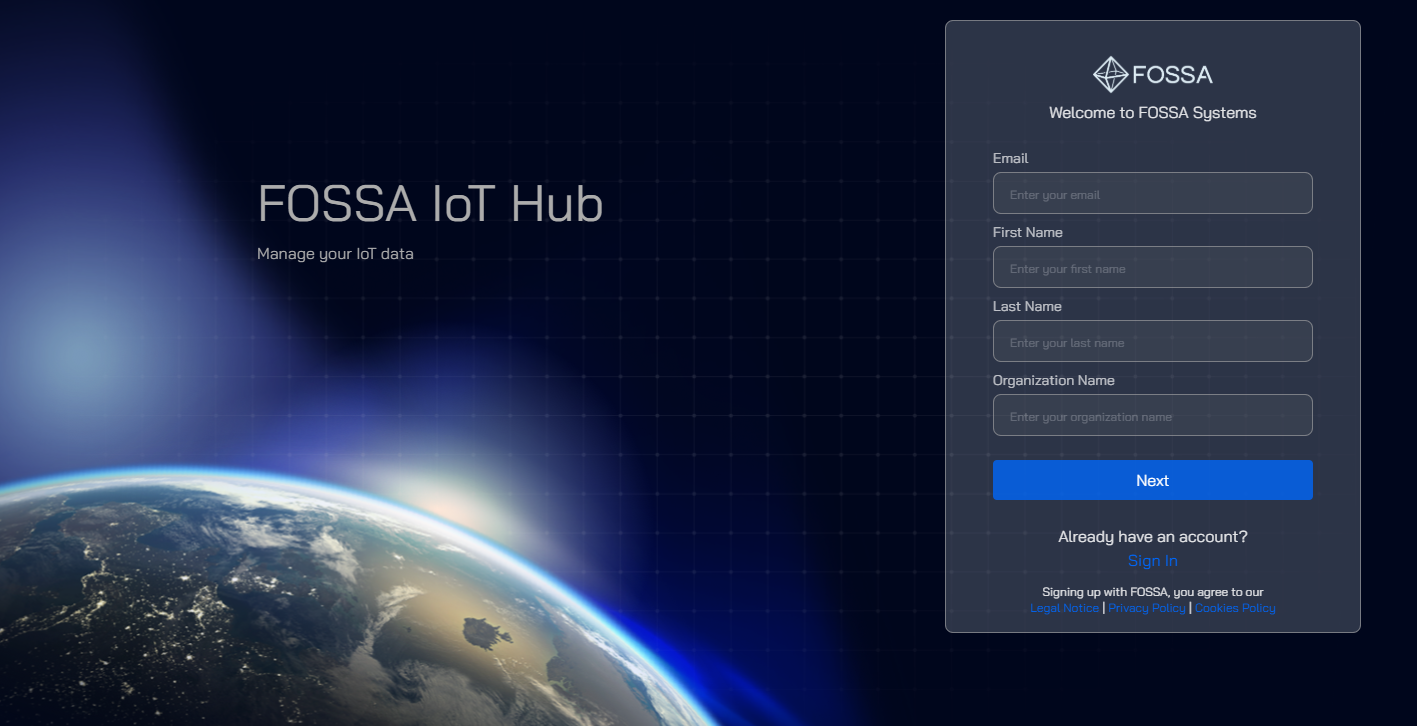
The first step to get started is to register your organization on the FOSSA IoT Hub. Access the Sign up page and fill in your company details.
2. Validate your organization
Once your organization is registered, you will receive an email to validate it. Click the link in the email to verify your identity. After this, FOSSA will review your registration and activate your account within the next few hours. You will receive an email letting you know that your organization is active and ready.
3. Device registration
Once your organization is active, you will be able to log in to your FOSSA IoT Hub to begin registering your first device. Click the  button to start the registration process. You will need the MAC address and the serial number located on the box along with your new device.
You can use the help button next to each field if you are not sure how to enter the information.
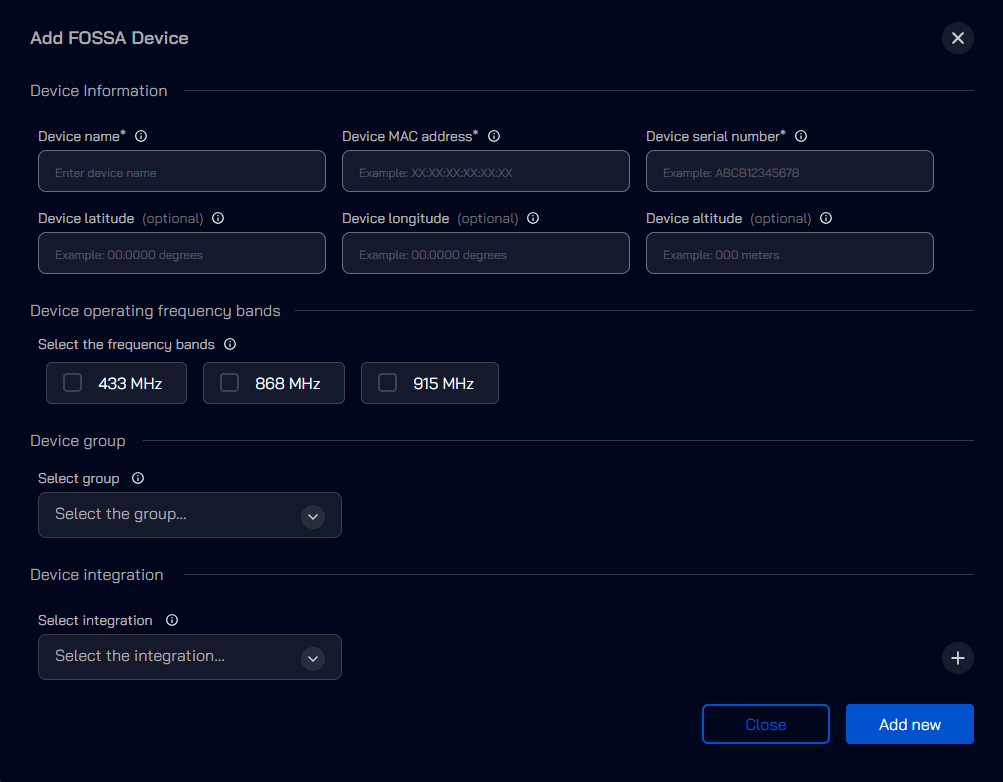
Note: Take into consideration that changes in the FOSSA IoT Hub, like GPS coordinates will not be automatically propagated to the device. A manual update will be needed.
4. Device Integrations
Integrations are a way to connect devices with your final applications or your cloud data ingestion. You can add one integration to each device. You can also add an integration to each group, as we will see in the next section.
An integration consists of a clear name (e.g., "Production Server") and an HTTP/S endpoint (e.g., https://production.example.com/sensors).
All the data that the device sends through the FOSSA Network will be routed to the configured integration.
You can find more information regarding how to properly configure an integration in section: Data Retrieval
5. Device Groups
Device groups on the FOSSA IoT Hub provide a way to cluster devices together, serving two distinct purposes:
- Simplify the management of multiple devices that share similar characteristics or user applications.
- Define a broadcast group to enable multicast commands to all devices within the same group.
Each device can belong to up to three groups, and one integration can be configured for each group in addition to the individual integration that each device might have. If a device has an individual integration and belongs to N groups, all data will be sent to the device’s integration as well as to all group integrations, with no additional cost.
When a device is added to a group, a new callsign is assigned to it. The device will listen on all its assigned callsigns, waiting for commands. Broadcast commands can be sent to a group from the FOSSA IoT Hub in the same way as individual commands, and all devices in the group will receive them.
Due to technical limitations of broadcast groups, optimal performance of multicast commands is achieved when all devices in a group are geographically close—ideally within a radius of approximately 100 km.
Note: Changes made in the FOSSA IoT Hub, such as group assignments or broadcast configurations, are not automatically propagated to the device. A manual update is required. This means that even if a device is assigned to a group on the FOSSA IoT Hub, it will not listen for broadcast commands until the change is manually applied to the device.
6. Commands
Commands are data sent from the FOSSA IoT Hub to the device.
To send a command, select a device on the FOSSA IoT Hub and click the  button.
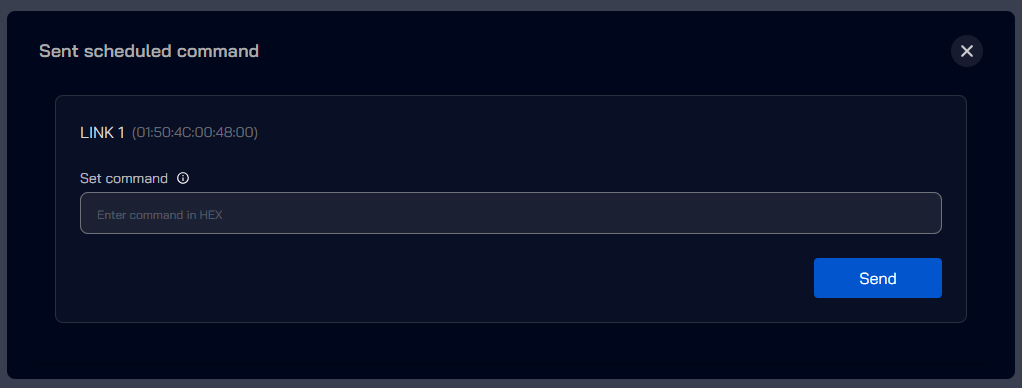
You can build any command for your device. However, due to cryptographic restrictions, it must be either 16 or 32 bytes long. Padding can be added to meet this requirement.
The command must be specified in hexadecimal format (e.g., "BEEF002F").
Commands are not sent instantly. They are scheduled within the satellite network and will be downlinked to the device during the next available pass. This process may take a few minutes or several hours depending on the geographical location.
Commands can also be sent to a group instead of an individual device. In that case, all devices in the group will receive the command.
7. Bulk and automated actions
If you want to automate device registration or send commands automatically from your company systems, you can use the programmatic REST API.
Go to the API Keys Manager section on the FOSSA IoT Hub and create an API key to authenticate your scripts.
Refer to the FOSSA IoT Hub API documentation for more information. Quotas and restrictions might apply. Please contact FOSSA for more details.